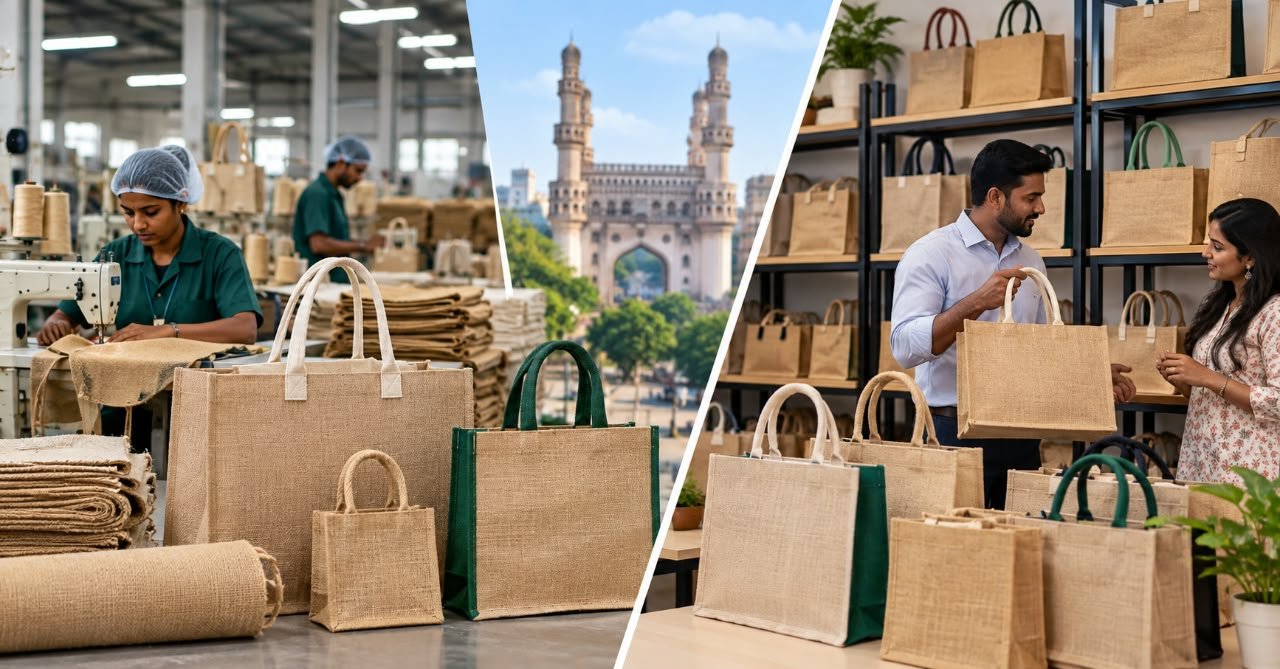
As businesses across Telangana shift toward sustainable packaging, jute bags have evolved from simple utility items into powerful branding tools. Whether you run a retail boutique in Banjara Hills, manage corporate events in HITEC City, or operate a supermarket chain across the twin cities, sourcing eco-friendly carry bags is a priority.
When looking for jute bags wholesale hyderabad hubs offer, business owners face a fundamental sourcing dilemma: Should you partner directly with an OEM manufacturer, or buy through local wholesalers and traders?
This guide provides a comprehensive breakdown of the trade-offs, pricing dynamics, customization capabilities, and the exact sourcing hubs across the twin cities.
The Wholesale Jute Landscape in Hyderabad & Secunderabad
Hyderabad and Secunderabad serve as prominent distribution and manufacturing hubs for eco-friendly textiles in South India. Sourcing channels fall into two categories:
- Commercial Trading Hubs: Traditional wholesale markets such as Begum Bazaar, General Bazaar, Ranigunj, and Feelkhana. These markets house numerous stockists, aggregators, and jute bags dealers in hyderabad who resell off-the-shelf goods.
- Direct Industrial Manufacturers: Dedicated fabrication units, print facilities, and stitching workshops located across industrial corridors like Jeedimetla, Balanagar, Cherlapally, Kattedan, and adjacent belts near Secunderabad.
Both channels serve distinct procurement needs, but their operating models differ in cost structure, quality control, and order flexibility.
Direct Manufacturer vs. Wholesale Trader: A Direct Comparison
To help you decide where to allocate your procurement budget, here is how both models perform across critical commercial factors:
| Procurement Factor | Direct Manufacturer (OEM) | Wholesale Trader / Middleman |
|---|---|---|
| Pricing | Factory-gate base price (no intermediary markups) | 20% to 45% markup added for retail inventory |
| Customization | Complete control over GSM, handles, piping, zippers, and sizing | Limited to catalog dimensions and generic templates |
| Branding & Printing | High-precision screen, flexo, or heat-transfer printing | Basic single-color overprinting on ready-made stock |
| Fabric Quality & GSM | Certified food-grade, laminated, or raw Golden Jute | Variable fabric density; often mixed blends |
| Lead Times | Made-to-order (typically 7 to 15 business days) | Immediate pickup for ready stock |
| Minimum Order (MOQ) | Moderate-to-high (typically 100 to 500+ units) | Low to flexible (often accommodates 20 to 50 units) |
Sourcing from Wholesale Traders & Dealers: Pros and Cons
Local trading hubs remain active for practical reasons, especially for urgent, small-scale requirements.
Advantages of Traders
- Immediate Availability: If you need 50 generic brown gift bags for an event tomorrow morning, jute bags suppliers in hyderabad trading markets maintain ready stock on warehouse shelves.
- Low Threshold MOQs: Dealers regularly break master cartons, enabling retail buyers to test small quantities without large upfront financial commitments.
- Physical Inspection: You can walk into markets like Begum Bazaar or General Bazaar, feel the texture, and walk away with your merchandise the same hour.
Disadvantages of Traders
- Compounded Margin Costs: Every layer in the distribution chain adds transport fees, warehouse overhead, and resale profits.
- Inconsistent Batch Quality: Traders often aggregate lots from varying mills. One carton may feature tightly woven 14x15 weave jute, while the next contains loose, shedding fabric.
- Restricted Custom Branding: Printing a multi-color company logo on a pre-stitched, pre-laminated bag often results in misaligned or bleeding artwork.
Sourcing Directly from a Manufacturer: Why It Pays Off
For corporate procurement heads, export houses, retail chains, and promotional marketers, working directly with primary producers yields tangible long-term dividends.
Supply Chain Comparison
Multiple markups added
Factory-direct pricing & precision specs
1. Significant Cost Reduction at Scale
Eliminating intermediary markups protects your bottom line. Direct factory billing delivers per-unit savings that compound significantly on volume orders of 500, 1,000, or 10,000 units.
2. Full Tailoring of Dimensions and Materials
A primary producer constructs your bag from raw rolls of natural jute, juco (a durable jute-cotton blend), or high-tensile burlap. You choose:
- Lamination: Polypropylene (PP) lining for moisture barrier, liquid resistance, and structural rigidity.
- Handles: Padded cotton rope, flat webbing tape, cane handles, or reinforced self-fabric straps.
- Accents: Contrast gussets, zippered internal pockets, magnetic closures, and custom hangtags.
3. Precision Brand Reproduction
When collaborating with dedicated jute bags manufacturers in secunderabad and Hyderabad, your company artwork is screen-printed onto flat fabric panels before stitching. This sequence guarantees sharp edge registration, accurate Pantone color matching, and full edge-to-edge layout execution.
Sourcing Partner: The Jute Bag Maker
When your organization requires consistent build quality, certified raw materials, and factory-direct pricing without the middleman premium, The Jute Bag Maker stands out as a dedicated manufacturer serving Hyderabad, Secunderabad, and shipping nationwide.
From export-grade shopping totes and corporate seminar folders to personalized wedding favor pouches, The Jute Bag Maker manages end-to-end fabric cutting, lamination, high-definition printing, and structural stitching under rigorous quality benchmarks.
Step-by-Step Checklist for Sourcing Jute Bags in Hyderabad
Before issuing a Purchase Order (PO) to any vendor, confirm these four technical criteria:
- Verify Fabric Density (GSM & Weave): Ensure your supplier specifies yarn count (e.g., 13x13 or 14x15 weave). Higher density fabrics resist seam pulling and support heavier weight loads.
- Inspect the Stitch Technique: Look for multi-thread chain stitching and reinforced "X" box stitches at handle stress points to prevent tearing under load.
- Check Lamination Integrity: For grocery, bottle, or agricultural packaging, verify that interior lamination is smooth, uniformly bonded, and free from peeling or chemical odors.
- Demand a Pre-Production Sample (PPS): Always greenlight a finished physical sample featuring your exact printed artwork prior to commencing mass production.